

Based on reporting by Casino.org →
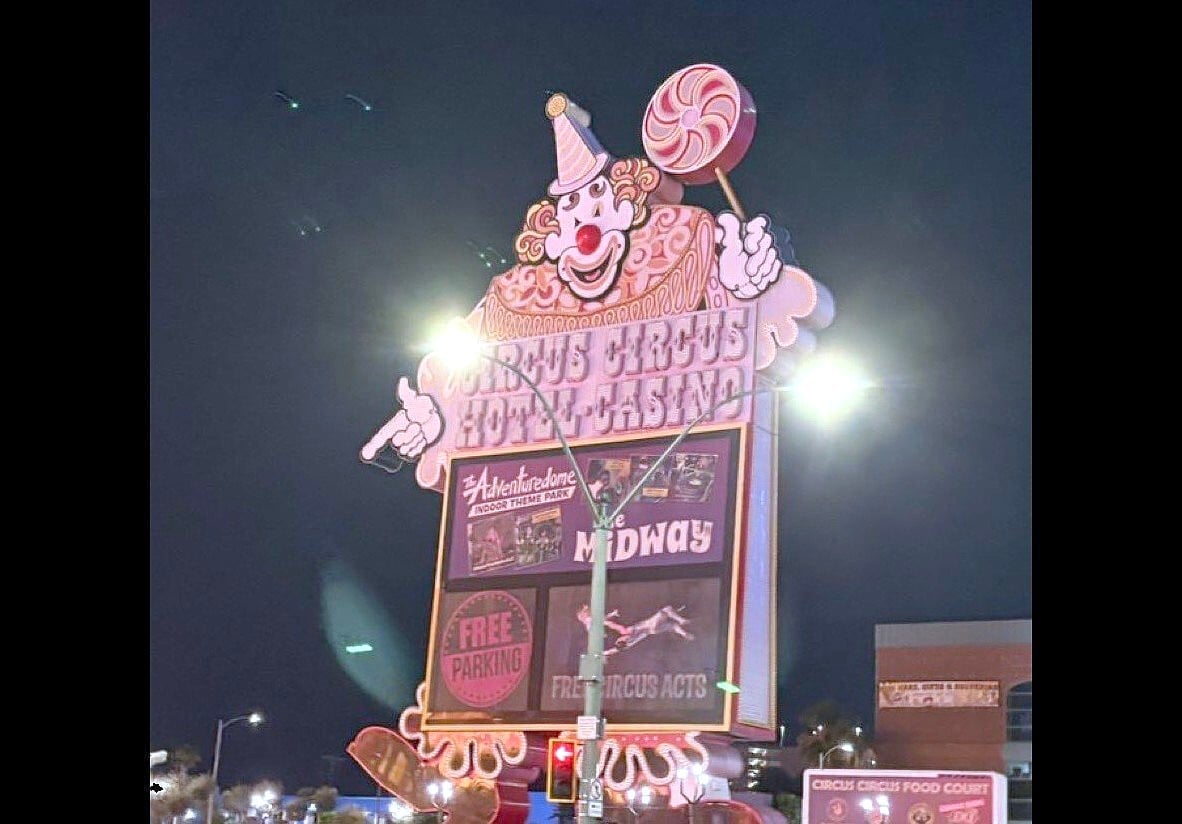
Las Vegas lost another piece of iconic neon history when Circus Circus unplugged its legendary Lucky the Clown sign earlier this summer. The 50-year-old landmark, which debuted in September 1976, represents one of the Strip's oldest surviving casino signs and has become a fixture in hundreds of Hollywood establishing shots over five decades.
The 123-foot-tall, 84-ton sign was designed by Dan Edwards and constructed by YESCO (Young Electric Sign Company) to reinforce Circus Circus's carnival theme and family-friendly branding. Its mid-century American circus aesthetic, inspired by Ringling Bros. and Barnum & Bailey, made it instantly recognizable. The sign even appeared in the 1995 Academy Award-winning film Leaving Las Vegas, cementing its status as a cultural artifact.
Trouble began in late 2025 when portions of the display started going dark intermittently. The sign's electrical system eventually failed beyond practical operation, prompting Circus Circus to take Lucky offline in summer 2026. According to reports, the casino's electrical infrastructure is "fried," creating a substantial repair burden.
The casino has indicated that restoration efforts are underway, with management currently gathering repair estimates. However, industry observers remain skeptical about the project's likelihood of completion. The uncertainty stems largely from the fact that Circus Circus's parent company, owned by Phil Ruffin, has listed the 102-acre property (including the adjacent Festival Grounds) for sale at $5 billion since early 2025 with no transaction announced to date.
Local Vegas commentator Shawn Coomer argued on his Miles to Memories podcast that the sign deserves restoration. He noted that casinos often choose to spend comparable capital on new digital screens rather than preserve historical signage. "This really is a treasure because there's no signs like it anymore," Coomer said, emphasizing the irreplaceability of mid-century neon craftsmanship.
Pessimistic observers suggest that if restoration does not materialize, Lucky's most likely fate would be relocation to the Neon Museum's boneyard, where many retired Las Vegas signs have found permanent homes when on-property preservation becomes infeasible. The museum has become the final resting place for iconic neon that cannot be maintained in situ.
From a market perspective, the Lucky sign's potential demise reflects a broader tension in casino operations between heritage preservation and capital allocation. As properties change hands or face sales pressure, legacy assets often become casualties of strategic repositioning. The fate of this particular sign will likely hinge on whether Ruffin's sale efforts succeed and what priorities an acquiring operator might establish for the Circus Circus brand's identity and curb appeal on the Strip.
Source
Casino.orgRelated stories

Station Casinos Awards $70M in Stock to Nearly 10,000 Employees for 50th Anniversary

Primero Games Acquires Win Systems Gaming Division to Expand Latin American Operations
Las Vegas Sands Crosses 75% Ownership Threshold in Sands China
Maverick Gaming Closes Two More Washington Cardrooms, Eliminates 238 Jobs
More on CasinoAdvisor